
Extraction of Impacted Wisdom Tooth
- The wisdom tooth, also called third molar, is the last tooth at the back of the jaws. Wisdom teeth normally erupt after the age of 18, but in some cases they do not erupt at all and remain fully or partially impacted due to lack of space. In other cases, they may be completely absent from the permanent dentition.
- In certain situations, surgical extraction of wisdom teeth is necessary, such as:
- Pericoronitis. This is the most common reason for extracting an impacted or, more often, a partially impacted wisdom tooth and is an inflammation of the gum covering it. Symptoms vary according to severity and may include pain, swelling, difficulty opening the mouth, fever, swollen lymph nodes, abscess formation, etc. Initial treatment is conservative, with cleaning of the area and, in more severe cases, antibiotics. The definitive treatment is extraction of the responsible wisdom tooth.
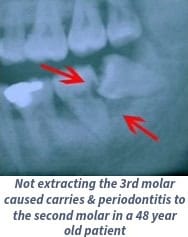
- Periodontitis. A wisdom tooth may often make it difficult to clean the adjacent second molar properly. This can cause periodontitis or worsen existing periodontal disease of the second molar. For this reason, the wisdom tooth is often removed preventively in order to preserve the much more important second molar.
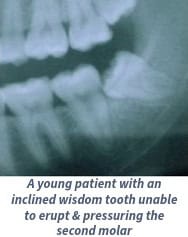
- Caries. As mentioned above, the wisdom tooth often does not erupt fully because of lack of space and may press against the neighbouring second molar at an angle. At the contact point between the two teeth there is a high risk of developing caries (a cavity) on the second molar.
- Orthodontic problems. The presence of wisdom teeth can aggravate or interfere with the progress of orthodontic treatment.
- Pathological bone lesions. Wisdom teeth, especially in the lower jaw, can in some cases be responsible for the development of odontogenic cysts, ameloblastoma and other lesions. In such cases, their removal is considered necessary.
- The surgical extraction of fully or partially impacted wisdom teeth is a routine procedure in our practice thanks to our specialization in all aspects of minor oral surgery. It is no coincidence that many colleague dentists trust us with their patients who need such extractions. The procedure is carried out painlessly under local anaesthesia and, with the appropriate medication, an uncomplicated postoperative course is ensured.

